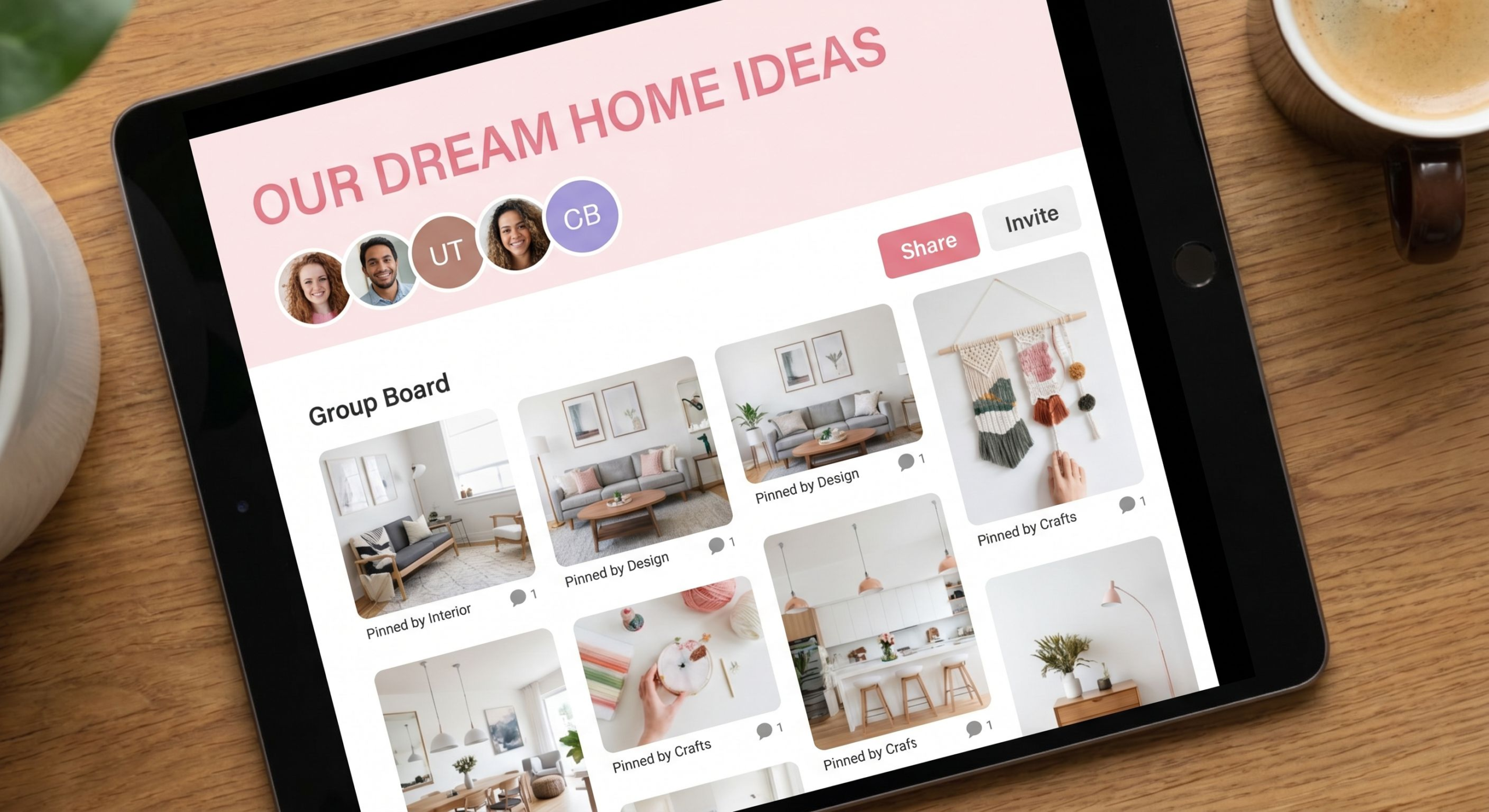
Pinterest Group Boards — boards where multiple contributors can add pins — were once the primary growth hack for Pinterest marketers. The landscape has changed significantly since their peak, but group boards aren’t dead: they’ve evolved. This guide gives you the honest 2026 assessment of group boards: where they still deliver value, how to use them strategically, and what to focus on instead when they’re not the right tool.
What Are Pinterest Group Boards?
A Pinterest Group Board is a collaborative board where the board owner invites other Pinterest users to contribute content. All contributors can pin to the board, and the board appears on all contributors’ profiles — meaning pins added to a well-followed group board can reach a much larger audience than the individual contributor’s own followers alone.
How Group Boards Work
The board owner creates the board and invites collaborators via email or Pinterest username. Contributors accept the invitation and gain pinning rights. When a contributor pins to the group board, it distributes to followers of the board (which includes all contributors’ followers). The owner controls board settings: who can contribute, the board topic, and board description.
Why Group Boards Were So Powerful
At their peak, group boards were legitimate audience amplifiers. A creator with 1,000 followers could contribute to a group board with 100,000 followers and immediately reach that entire audience. For niche topics, the right group board could 10x or 100x your potential pin reach in a single contribution.
The Current State of Pinterest Group Boards in 2026
Group boards have declined in effectiveness for several reasons, but understanding exactly why reveals where they still provide value.
Why Pinterest Changed the Algorithm Around Group Boards
Pinterest reduced the algorithmic boost given to group board pins starting around 2019 and has continued deprioritizing them relative to fresh individual pins. The primary reason: low-quality group boards were being used to spam unrelated content, degrading the experience for Pinterest users. Pinterest’s response was to weight individual account quality and pin freshness more heavily than board follower counts in distribution decisions.
What Still Works in 2026
High-quality, niche-specific group boards with active moderation and relevant contributors still provide genuine distribution value. The key differentiator is whether the board’s contributors are posting relevant, high-quality content. Boards that have been curated carefully — where off-topic pins get removed and contributors are vetted — retain algorithmic credibility. Abandoned or spammy group boards provide little to no benefit.
How to Find Group Boards Worth Joining
Quality filtering is essential when seeking group boards. Here’s how to identify the ones worth joining in 2026.
Searching Pinterest for Group Boards
Search your primary keyword on Pinterest (e.g., “home decor ideas”). In the results, filter to show Boards. Group boards are identifiable by the multiple circular avatars shown in the board preview — these represent the contributors. Click into boards that appear in your niche and assess their quality.
Quality Criteria for Group Boards
Evaluate potential group boards by: follower count (100K+ is meaningful), recent activity (pins added within the last 7 days), content relevance (90%+ of pins are on-topic for your niche), contributor quality (contributors have active, quality profiles), and engagement signals (pins on the board have saves and comments). A board with 500K followers but no activity in 3 months is worthless.
Using PinGroupie and Similar Tools
Third-party tools like PinGroupie catalog Pinterest group boards with metrics including follower count, contributor count, and recent activity. These tools help you discover boards in your niche quickly without manual searching. Verify metrics independently — tool data isn’t always current.
How to Join Pinterest Group Boards
Most group boards are invite-only — the board owner must add you. Getting accepted requires direct outreach.
Step 1: Prepare Your Pinterest Profile
Before requesting to join any group board, ensure your profile is optimized: complete bio with keywords, professional profile photo, consistent posting history of quality pins, and at least 5-10 well-curated personal boards. Board owners review your profile before approving you. A sparse, low-quality profile almost guarantees rejection.
Step 2: Send a Personalized Request
Find the board owner’s profile. Send a direct message or find their contact email (often in their bio). Write a brief, genuine message: introduce yourself, reference specifically why you’d be a good contributor (show you know their board’s content style), offer something in return (reciprocal pinning, content contributions, sharing their pins), and include a link to your profile. Generic copy-paste requests rarely get responses.
Step 3: Follow Up Once
If you don’t hear back in 2 weeks, send one follow-up. If still no response, move on. Don’t repeat-message — it’s off-putting and can get you blocked, which is the opposite of the relationship you’re trying to build.
Group Boards vs. Personal Boards vs. Tailwind Communities
| Feature | Group Boards | Personal Boards | Tailwind Communities |
|---|---|---|---|
| Distribution to non-followers | Yes (via board followers) | No | Yes (via community members) |
| Quality control | Variable (owner-dependent) | Full control | Community-managed |
| Algorithm favorability (2026) | Declining | Strong | Moderate |
| Setup effort | High (outreach required) | Low | Medium |
| Cost | Free | Free | Requires Tailwind subscription |
| Risk of spam association | Medium-High | None | Low |
Building Your Own Group Board
For established Pinterest creators, owning a high-quality group board is more valuable than contributing to others’ boards.
Why Owning a Group Board Builds Authority
Owning a well-followed group board makes you a curator and connector in your niche — a position of authority. You control quality standards, invite the contributors who align with your vision, and benefit from the combined follower base of all contributors. Your name appears as the board owner in all participants’ profiles, building brand recognition across your niche.
How to Grow a Group Board You Own
Start with a specific niche topic (not too broad). Invite 5-10 high-quality creators in your niche as initial contributors. Set clear pinning guidelines in the board description. Actively curate by removing off-topic or low-quality pins. As the board grows, your invitation becomes more attractive — creators want to join boards with real audiences.
FAQ: Pinterest Group Boards
Are Pinterest group boards still effective in 2026?
Selectively, yes. High-quality, niche-specific, actively moderated group boards still provide distribution benefits. Generic, high-volume, poorly moderated boards provide little value and may associate your account with spam signals. Quality filtering is essential.
How many group boards should I contribute to?
5-15 relevant, high-quality group boards is a reasonable target. Contributing to too many (50+) was a common strategy that Pinterest’s algorithm has specifically penalized. Quality and relevance of boards matters far more than quantity.
How do I find the owner of a group board?
Click on the group board to open it. The board owner appears first in the contributor avatar list (hover to see names on desktop). Click their avatar to visit their profile and find contact information.
Can I pin to group boards using scheduling tools?
Yes. Tools like Tailwind allow you to schedule pins to group boards alongside your personal boards. This makes contribution easy to maintain consistently without daily manual pinning.
How do I remove myself from a Pinterest group board?
Click on the group board, then click the “Leave Board” option in the board settings (usually accessible via the three-dot menu). Note that any pins you added to the board before leaving may remain on the board, at the owner’s discretion.
Why did Pinterest remove the ability to see board followers?
Pinterest removed public board follower counts as part of broader changes to focus on content quality over social proof metrics. You can still see follower counts in Pinterest Analytics for boards you own. For other boards, third-party tools still aggregate historical data.
Conclusion
Pinterest Group Boards in 2026 are a supporting strategy, not a primary one. Invest the majority of your Pinterest energy in creating fresh, high-quality pins for your own boards, using keyword-rich descriptions, and posting consistently. Then selectively participate in 5-15 well-curated group boards in your niche as a distribution amplifier — not as a growth shortcut. The creators building sustainable Pinterest growth today are doing it through genuine content quality and strategic keyword optimization, not through gaming distribution systems. Group boards, used right, complement that foundation — they don’t replace it.